
The Industrial AI Gap
Why the distance between what AI can do and what industry is actually deploying remains wider than most conversations acknowledge

There is a version of the AI story that goes like this: frontier models are extraordinary, capabilities are compounding, and adoption is accelerating everywhere. That version is not wrong. It is just incomplete in a way that matters enormously if you are trying to deploy AI inside a real industrial organization — not a software company, not a research lab, but a place that makes physical things, moves physical goods, or operates physical infrastructure.
The version that is missing is this: the gap between what AI can do in a controlled demonstration and what AI can reliably do inside an industrial process at scale remains wide, poorly understood by most decision-makers, and systematically overstated by most vendors. Understanding that gap precisely — not pessimistically, not optimistically, but accurately — is the starting point for any serious conversation about industrial AI adoption.
That is what this post is about.

What the gap actually is
The clearest way to see the gap is to look at where the research frontier actually stands, and then ask honestly what it takes to get from there to a running industrial deployment.
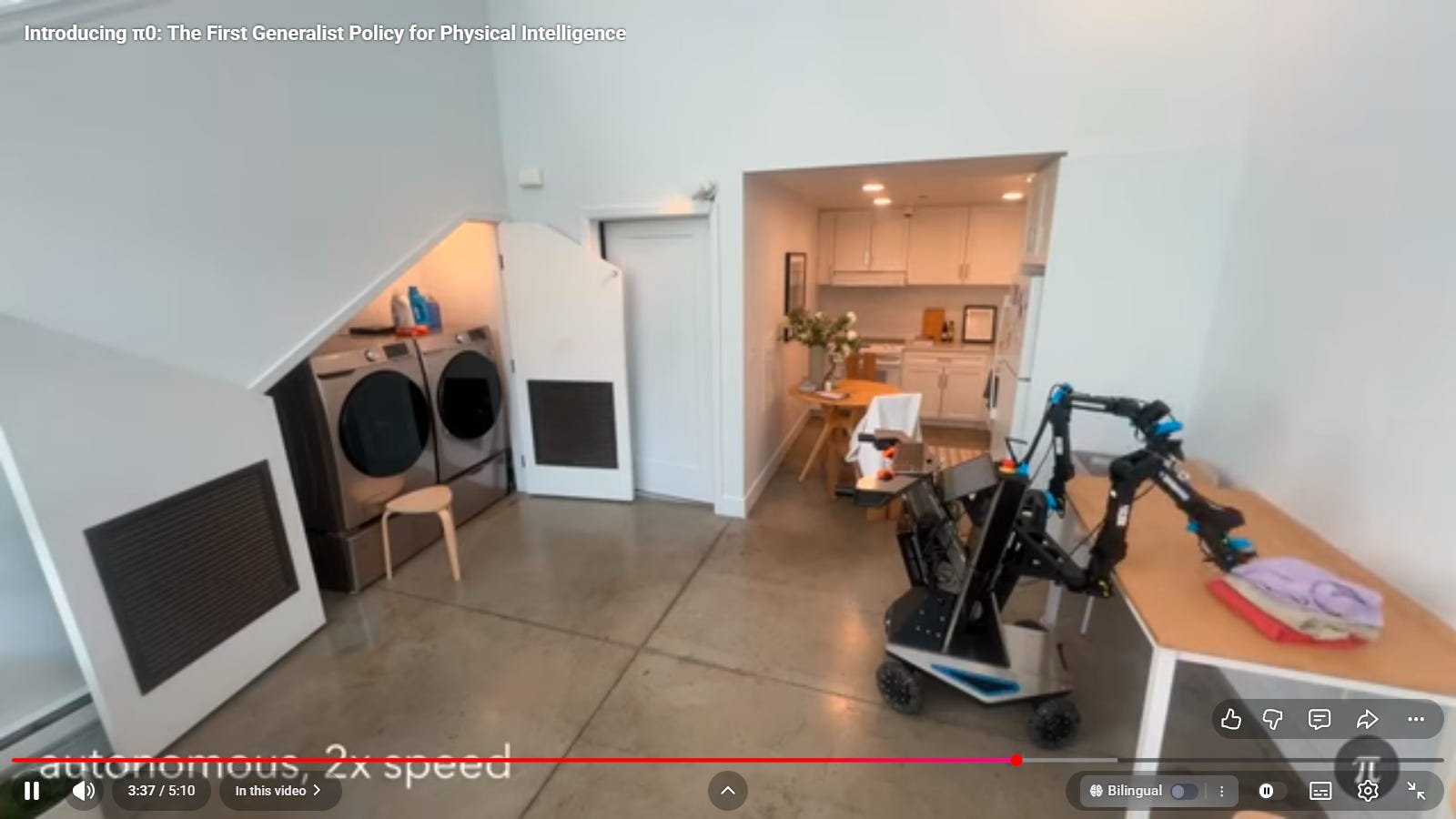
Physical Intelligence — the San Francisco-based robotics AI company founded by some of the field’s leading researchers — published their first generalist robot policy, π0, in late 2024. The work represents one of the most serious attempts to date to build a foundation model for physical AI: a single model, trained on Internet-scale vision-language pretraining combined with cross-embodiment robot interaction data from eight distinct robotic platforms and the Open X-Embodiment dataset, capable of controlling a wide variety of robots across a wide variety of tasks. The architecture pairs a pretrained vision-language model with a novel action expert that outputs continuous motor commands at up to 50 Hz via flow matching — a variant of diffusion models — enabling a level of dexterity that previous robotic learning systems could not approach.
The results are genuinely impressive. After pre-training, π0 can be fine-tuned on roughly 20 hours of high-quality task-specific demonstrations to perform complex manipulation tasks that no prior robot learning system had demonstrated successfully at this level: folding laundry from a tangled hamper, bussing a table with mixed objects and emergent multi-object strategies, assembling a cardboard box by monitoring its own progress and adjusting in real time. Compared to prior models — OpenVLA and Octo being the most direct baselines — π0 outperforms them by a margin that is not marginal. On shirt folding, grocery bagging, and toast-from-toaster tasks, the competing models score effectively zero. The key insight enabling this is the asymmetry between pre-training and fine-tuning: vast, diverse cross-embodiment pre-training creates a foundation that can be specialized to new tasks with surprisingly little data. The end-to-end model inherits the lessons from explicit vision — the semantic understanding of the physical world accumulated from Internet-scale pretraining transfers into physical capability.
This is genuine progress, made by serious people, documented rigorously. And it still does not close the industrial AI gap. Understanding why is the point.
When researchers at Berkeley frame the challenge of end-to-end robotic learning, they identify three problems that have not gone away: generalization to diverse scenarios, getting enough data, and robustness at operational speed. These are not academic concerns. They are precisely the three problems that industrial deployment runs into first, hardest, and most expensively.
The industrial AI gap is not a gap in ambition or even in frontier capability. It is a gap in the integration surface — the distance between a capability demonstrated under controlled conditions and a capability that runs reliably, safely, and economically inside an industrial process that was not designed with AI in mind.
Three dimensions of the gap
1. The generalization problem in industrial context
A machine learning model generalizes when it performs well on inputs that differ from its training distribution. Industrial environments are adversarial to generalization in ways that benchmark datasets rarely capture: lighting conditions shift, components vary across suppliers, processes drift over months, and edge cases accumulate in ways that no pre-training corpus fully anticipates.
The solution the research community has converged on — large-scale pre-training on diverse data, followed by narrow task-specific fine-tuning — works well when the fine-tuning data is high quality and the deployment environment stays close to the fine-tuning distribution. In industrial settings, both of those conditions are fragile. Quality labeled data is expensive to produce. Deployment environments evolve. The generalization problem does not disappear; it gets managed, at cost, continuously.
Decision-makers who evaluate AI systems on vendor demonstrations are not seeing this cost. They are seeing the fine-tuning distribution. The gap becomes visible later, in production, when it is more expensive to close.
2. The data problem in industrial context
The π0 training pipeline required approximately 10,000 hours of pre-training data across diverse embodiments. Most industrial organizations do not have anything close to that volume of structured, labeled operational data — and the data they do have is often locked in proprietary systems, inconsistently formatted, and not collected with machine learning in mind.
This creates a structural asymmetry: the organizations with the most to gain from physical AI deployment are often the ones with the least usable data to fine-tune on. The research community’s answers — cross-embodiment pre-training, simulation-to-real transfer, data augmentation — help, but do not eliminate the asymmetry on their own.
There are practical paths forward, and they are worth naming directly. Simulation environments such as NVIDIA Isaac Sim and MuJoCo allow organizations to generate synthetic training data at scale for specific process scenarios before any physical robot is deployed — reducing the real-world data burden substantially. Teleoperation pipelines, where human operators demonstrate tasks through remote control, are increasingly used to collect high-quality demonstration data efficiently; Physical Intelligence itself uses this approach for its post-training datasets. Data consortia — where multiple companies in the same vertical pool anonymized operational data — are beginning to emerge in sectors like logistics and manufacturing, allowing smaller organizations to contribute to and benefit from pre-training datasets they could not build alone. And the fine-tuning asymmetry, while real, is improving: the π0 results suggest that 20 hours of high-quality task-specific data can unlock significant capability when the foundation is strong. The practical implication for industrial organizations is that data strategy should begin before AI deployment is planned — documenting processes at the resolution machine learning requires, instrumenting equipment to capture operational data, and identifying which tasks generate the most reusable demonstration data.
None of this is trivial. But it is tractable, and organizations that start building their data infrastructure now will have a material advantage when the deployment tools mature.
3. The robustness and speed problem in industrial context
Robustness in a research context means performing well on out-of-distribution inputs. Robustness in an industrial context means something harder: performing within specification, every cycle, with documented failure modes, under regulatory scrutiny, alongside human workers, with defined recovery procedures when things go wrong.
Speed compounds this. Industrial processes have cycle time requirements. A robot policy that achieves high task success at reduced speed may not meet the throughput specification that justifies the capital investment. Reinforcement learning — the standard tool for improving robustness and speed — requires an environment to practice in. Industrial environments are not simulation sandboxes.
Why the gap is consistently underestimated
There are three structural reasons why the industrial AI gap tends to be underestimated in public discourse, and none of them involve bad faith.
The first is vendor incentive. AI system vendors are selling capability demonstrations, not integration complexity. A demonstration that shows 90% task success on a curated dataset says nothing about what happens when that system meets the tail of a real industrial process.
The second is benchmark inflation. The research community measures progress on benchmarks. Benchmarks improve. Benchmark improvement creates the impression of universal progress. But the distance between benchmark performance and industrial deployment reliability is not captured in any benchmark — including the impressive ones from the frontier labs.
The third is organizational optimism. Industrial organizations evaluating AI adoption are often led by people who have seen compelling demonstrations and understand the strategic stakes of falling behind. That is the right instinct. But it can lead to underestimating the integration work — the data preparation, the safety validation, the process redesign, the change management — that sits between a demonstration and a deployment.
None of this is an argument against industrial AI adoption. It is an argument for approaching it with the same discipline that serious engineering projects have always demanded: clear problem definition, honest capability assessment, staged deployment, and continuous measurement.
What closing the gap actually requires
Closing the industrial AI gap is an integration problem as much as a technology problem. It requires organizations to do three things that are genuinely difficult.
First, map their processes honestly — not at the level of “we make widgets” but at the level of where perception, decision, and action actually happen, where the data lives, and where the failure modes are consequential. This is harder than it sounds. Most industrial processes have never been documented at the resolution that AI integration requires.
Second, assess their data realistically — not just whether data exists, but whether it is structured, labeled, accessible, and representative of the deployment distribution. Data strategy is the unsexy prerequisite that determines whether fine-tuning will work.
Third, stage their deployments conservatively — starting where the failure modes are low-consequence and the generalization requirements are narrow, building operational confidence before expanding scope. The organizations that will have the most capable industrial AI systems in five years are the ones starting the smallest, most rigorous pilots today.
These are not novel insights. They are the lessons that every serious technology deployment programme has had to learn. AI is not exempt from them.
What this means for Robothropic AI
Robothropic AI exists in the space between the research frontier and industrial reality. The publication’s and project purpose is not to celebrate AI capabilities — there is no shortage of that — but to map the integration surface honestly, build tools that help organizations understand it, and work with partners who are serious about closing the gap rather than paper-covering it.
The Industrial AI Gap is the starting point because it is the honest starting point. Everything else we build here — the analytical frameworks, the open-source tools, the co-innovation model — is an answer to it.
Post 02 goes deeper into the mechanics: what agentic AI actually is, architecturally, and why it changes what the integration surface looks like.
Robothropic AI publishes at the intersection of AI research, industrial deployment, and physical systems. If this framing resonates with your work, share it with someone who needs to hear it. A project created and imagined by Nuno Edgar Nunes Fernandes - Engineer in Physics.